
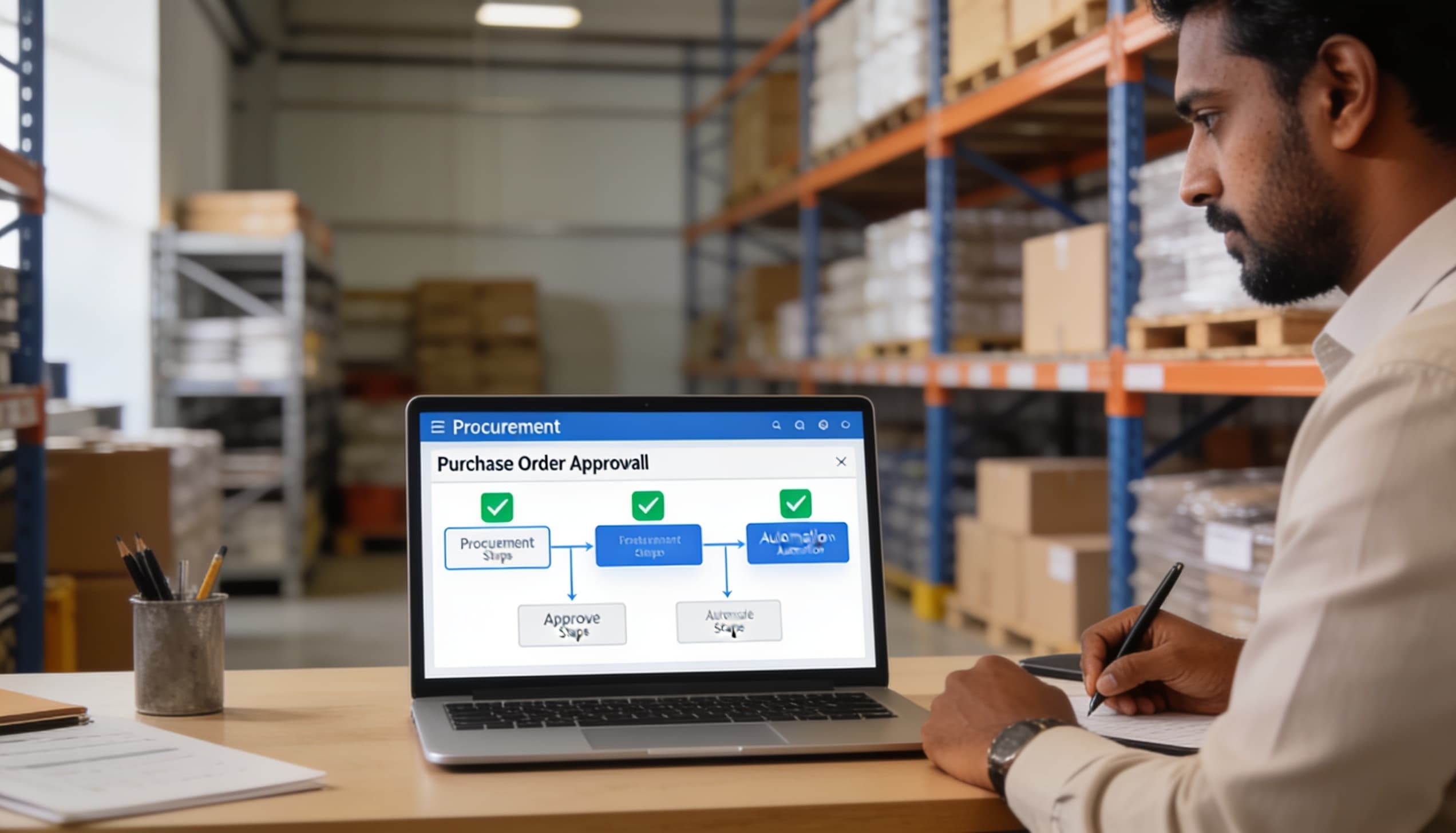
Automating purchase order approval means replacing email-and-spreadsheet sign-offs with a digital workflow: a structured PO form, rule-based routing by amount and department, automatic budget and supplier checks, and integration with your accounting or ERP system. Once set up, a request that used to sit in someone's inbox for two days gets approved — or flagged — within hours, with a full audit trail attached. See our business process automation guide for Indian SMEs for how PO approval fits alongside GST, payments, and reconciliation.
For most Indian SMEs, this isn't a nice-to-have. It's the difference between production waiting on stock and stock arriving on time.
Why manual PO approval is quietly draining working capital
Most small and mid-size businesses in India still run purchasing through a mix of email, WhatsApp, phone calls, and spreadsheets. It holds together at low volume. It breaks the moment a company adds a second location, a second approver, or a second supplier category.
The cost shows up in three places:
Manual purchase order approvals typically add 2-3 days of delay per request in Indian MSMEs, compared to a same-day turnaround when routing and thresholds are automated. That delay compounds — a distributor waiting on three POs a week loses close to two weeks of lead time a month.
Reconciliation gaps from manual tracking can tie up as much as ₹2.5 lakh in working capital a month for a mid-size SME, simply because nobody has real-time visibility into what's been ordered, approved, and paid for.
And it's not just delay — it's cost per transaction. Businesses running procurement manually spend roughly 35% more per invoice than those with automated workflows, mostly in the form of duplicate orders, missed early-payment discounts, and staff hours spent chasing approvals.
Separately, industry surveys of Indian MSMEs find that 67% struggle to manage multiple suppliers and 56% report recurring issues with non-compliant invoices and payment terms — both symptoms of a procurement process that runs on memory and inbox search instead of a system.
What automated PO approval actually looks like
A working PO automation setup has four parts:
Structured requests. Instead of an email with "need 200 units, urgent," staff submit a digital form with item, quantity, cost center, and justification. No more re-typing details into an ERP later.
Threshold-based routing. Low-value requests (say, under ₹25,000) get auto-approved or go straight to the direct manager. Anything above a set threshold routes to a department head or finance, and above a second threshold, to the owner or CFO. Nobody has to decide who approves what — the system already knows.
Automatic validation. Before a request even reaches an approver, the system checks it against budget limits and flags requests tied to suppliers with expired contracts, pending disputes, or GST mismatches. Bad requests get caught before money is committed, not after.
Integration and visibility. The workflow connects to whatever you already run — Tally, Zoho Books, an ERP, or a plain accounting sheet — so approved POs turn into purchase records automatically, and finance sees committed spend in real time instead of at month-end.
Approvals themselves can run over WhatsApp or email notifications with one-tap approve/reject, so a manager traveling between sites isn't the bottleneck.
Example: a Kolkata packaging distributor
A mid-size packaging distributor we've seen this pattern in ran purchasing through a shared spreadsheet and a WhatsApp group. Branch managers typed in requests, the owner approved from his phone when he saw the message, and finance re-entered everything into Tally at week's end.
Two recurring problems: duplicate orders when two branches requested the same material without knowing it, and a week-long lag between order and recorded expense that made cash flow planning close to guesswork.
After moving to a rule-based digital workflow — branch requests under ₹15,000 auto-approved, anything higher routed to the owner with one-tap WhatsApp approval, and every approved PO syncing to Tally automatically — average approval time dropped from just under three days to same-day, and duplicate orders stopped almost entirely because the system flagged repeat requests for the same item within a set window.
What to check before you automate
Before picking a tool or vendor, map these out:
Your actual approval hierarchy today — who approves what, at what amount, and where exceptions happen. Automation exposes gaps in this that spreadsheets hide.
Whether the workflow needs to write into your existing accounting system (Tally, Zoho, Busy, SAP B1) or just run alongside it with a manual export step.
Audit trail requirements — for GST input credit claims and internal audits, you need a timestamped record of who requested, who approved, and what changed, not just a final PO number.
Mobile approval support — if your approvers are often on the shop floor or traveling between sites, a workflow that only works on desktop won't get adopted.
FAQ
How long does it take to set up PO approval automation?
For a single-location SME with 2-3 approval tiers, a working setup typically takes two to four weeks, including mapping your approval rules and connecting to your existing accounting software.
Does this replace our ERP?
No. PO approval automation usually sits on top of or feeds into your existing ERP or accounting software — it replaces the manual routing and follow-up, not your bookkeeping system.
Is this only useful for manufacturing or distribution businesses?
No — any business with more than one approver in the purchasing chain benefits, including services firms buying equipment or subscriptions and retailers managing supplier restocking.
What if our approval rules change often?
Rule-based systems are built to be edited without a developer — thresholds, approver chains, and validation checks are configuration, not code.
Manual purchase order approval costs Indian SMEs time, working capital, and avoidable duplicate spend. If your procurement still runs on email and spreadsheets, a rule-based workflow can be running within a month. Talk to Firstly Solutions about workflow automation to see what it would look like for your approval chain.
See our complete guide to business process automation for Indian SMEs for how this fits alongside GST invoicing, payment collection, and reconciliation.