
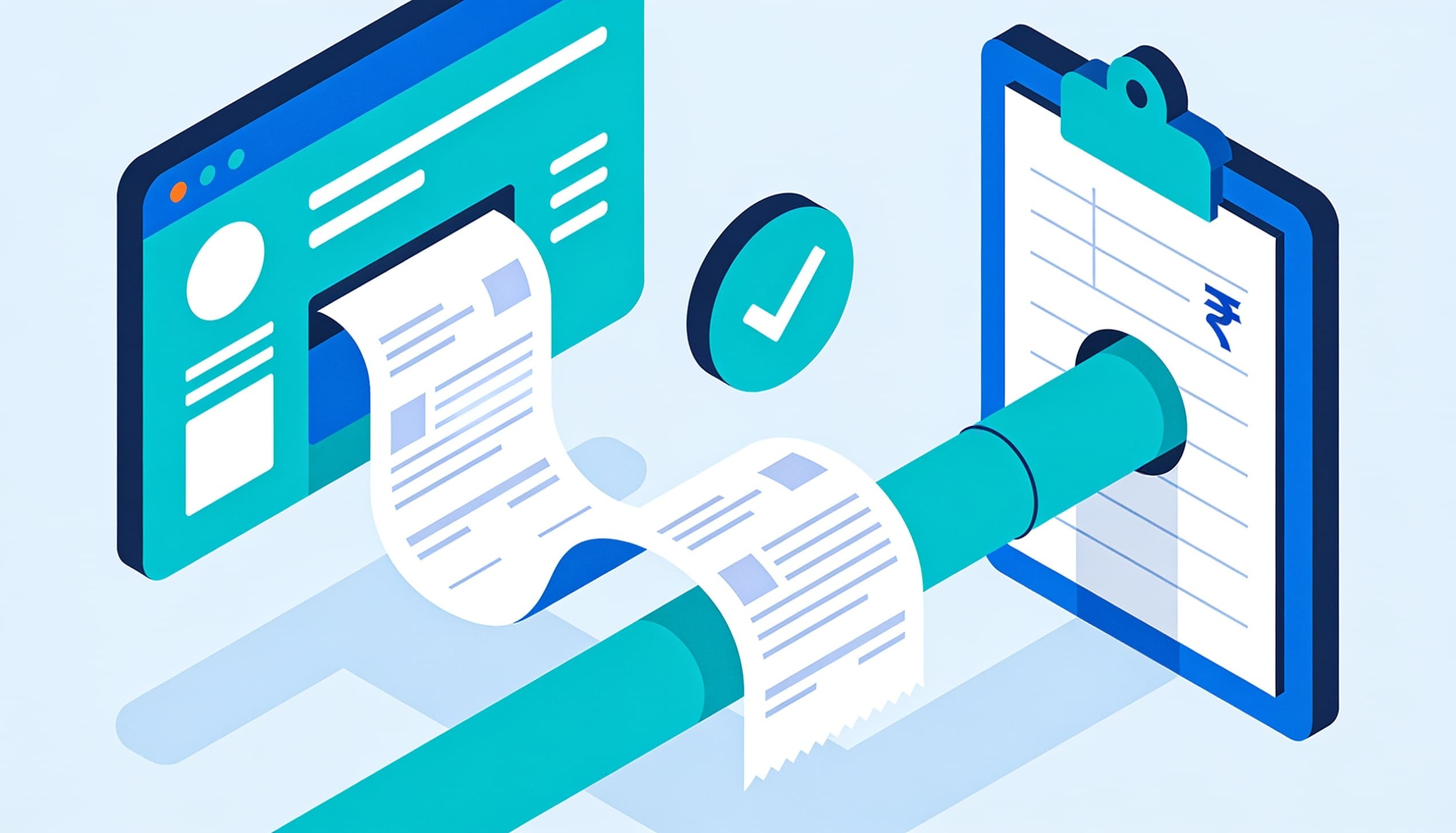
Automating GST invoice processing means replacing manual entry with a pipeline that reads each vendor invoice, checks it against GST rules, routes it for approval, and posts it to your accounting system without a person retyping numbers. For most Indian SMBs, that pipeline has four parts: OCR capture, GST compliance validation (GSTIN status, GSTR-2B cross-check, IRN/QR verification), approval routing, and ERP or Tally posting. Businesses that build this typically cut invoice-processing costs by 60-80% and stop losing input tax credit to invoices that were valid but filed wrong. If GST invoicing isn't your highest-priority manual process, our guide to business process automation for Indian SMEs covers where else to start.
Why manual invoice processing breaks down in India
A typical Indian SMB receives 50-200 vendor invoices a month. At 5-10 minutes each for reading, verifying, and entering into Tally or another accounting system, that's 4-16 hours of pure data entry — before anyone checks whether the invoice is actually GST-compliant.
The breaking point isn't volume, it's compliance load. Once a business crosses roughly 300-500 invoices a month, manual GST verification stops being sustainable. At that scale, a single accounts payable staffer can spend 40-50% of their time just on GST-related checks: confirming the vendor's GSTIN is active, cross-referencing the invoice against GSTR-2B, and verifying the IRN and QR code on e-invoices.
The cost of getting this wrong is specific and enforceable. An e-invoice without a valid IRN is not a valid tax document under the GST framework — it blocks the buyer's input tax credit and can draw penalties up to ₹10,000 per invoice, or 100% of the tax due, under Section 122 of the CGST Act. Manual entry error rates run 1-3% in general, and higher in India given GST complexity, inconsistent vendor formats, and photographed or WhatsApp-forwarded invoices with poor image quality.
What a GST-compliant automated pipeline actually does
- OCR capture — reads PDFs, scanned images, and even WhatsApp-forwarded photos of invoices, pulling out GSTIN, HSN/SAC codes, and line-item GST rates automatically.
- Compliance validation — checks the vendor's GSTIN status, cross-references the invoice against GSTR-2B, and confirms the IRN and QR code are present and valid.
- Approval routing — sends the invoice to the right approver based on a value/department matrix, instead of a clerk chasing signatures over email.
- ERP posting — pushes the verified invoice straight into Tally or your ERP, with duplicate detection so the same invoice can't be paid twice.
Two compliance details matter for timing this correctly. E-invoicing has been mandatory for B2B transactions since August 2023 for any business with turnover above ₹5 crore. And since April 2025, businesses with turnover of ₹10 crore or more can no longer report e-invoices to the IRP portal if they're more than 30 days old — so any automation has to be fast enough to keep invoices inside that window, not just accurate.
A concrete example
For clarity: this is an illustrative scenario based on patterns we see across Indian SMEs, not a specific client engagement.
A West Bengal-based industrial parts distributor processing around 180 vendor invoices a month had one accounts clerk doing all of it manually — many invoices arrived as phone photos forwarded over WhatsApp by field staff, with inconsistent formatting and occasional missing GSTIN numbers. The clerk was spending roughly 20 hours a month on entry and another 8-10 hours chasing down GST mismatches before the monthly GSTR filing, and twice in one year the business lost input tax credit because an e-invoice's IRN hadn't been checked before payment.
Moving to an automated pipeline — OCR reading the WhatsApp photos directly, GSTIN and IRN validation running automatically, and verified invoices posting straight to Tally — cut the clerk's monthly invoice workload to about 4 hours of exception handling, and eliminated the ITC losses because invalid invoices got flagged before payment instead of after filing.
What implementation actually takes
Most mid-market deployments in India go live in 4-6 weeks:
- Weeks 1-2: Baseline and approval matrix. Measure current cycle time, exception rate, and ITC-miss rate before touching any configuration. Document who approves what, at which value thresholds, for which departments — this drives everything downstream.
- Weeks 3-4: Configuration and ERP connection. Train the OCR on your actual vendor invoice formats, set up compliance rules, configure approval workflows, and connect to Tally or your ERP.
- Weeks 5-6: Parallel run and cutover, with the old manual process kept as a fallback until the automated numbers match.
On cost: manual data entry labor in India runs roughly ₹15,000-₹30,000/month per junior staffer, while a workflow automation setup typically costs ₹5,000-₹25,000/month depending on invoice volume — and unlike a staffer, it doesn't add proportionally more error risk as volume grows.
FAQ
Is invoice automation only worth it for large enterprises?
No — the compliance burden that makes manual processing unsustainable (GSTIN checks, GSTR-2B matching, IRN/QR verification) kicks in around 300-500 invoices a month, a volume plenty of mid-sized SMBs already hit.
Does automated invoice processing work with Tally?
Yes. A properly built pipeline posts verified invoices directly into Tally or whatever ERP you already use — it's designed to sit in front of your existing accounting software, not replace it.
What happens if a vendor's e-invoice is missing an IRN?
It should be flagged and held before payment, not after. An invoice without a valid IRN isn't a valid GST document, and paying it anyway risks blocked input tax credit and penalties under Section 122 of the CGST Act.
How long does an implementation take?
Most Indian mid-market rollouts go live in 4-6 weeks: two weeks to baseline your current process and approval matrix, two weeks to configure OCR and compliance rules and connect your ERP, and a parallel-run period before full cutover.
If manual invoice processing is eating your accounts team's hours or you've had an input tax credit claim rejected over a missed IRN, Firstly Solutions builds workflow automation that connects OCR, GST compliance checks, and your existing ERP into one pipeline.
For the wider playbook — procurement, payments, HR, and customer support automation — see our complete guide to business process automation for Indian SMEs.